


Structural Cracks in UK Homes
While most homes in the UK experience some level of non-structural hairline cracking due to thermal movement, cracks can sometimes be more severe, often linked to serious issues such as subsidence or soil heave (the latter described in a different useful information post).
Cracks that are usually thicker than 3 millimetres (roughly the thickness of a pound coin or larger) and get wider as they move away from the starting point could be a result of something more sinister.
The main publications that classify cracks in detail are BRE Digest 251 (Assessment of damage in low-rise buildings) and BR 292 (Cracking in buildings).
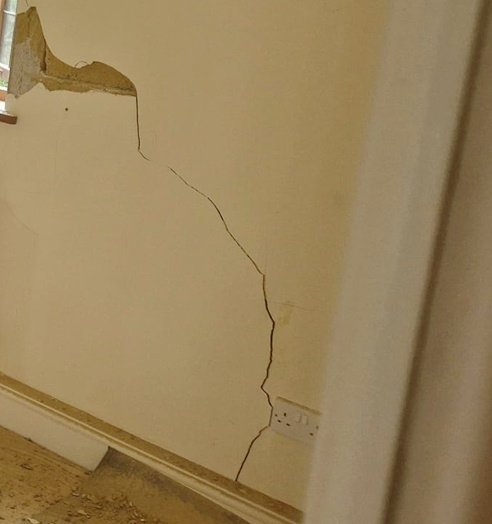
Overview of subsidence crack
What is subsidence?
Subsidence is differential movement in which the foundations of a building drop unevenly, which puts a high level of stress on the walls. As a result, large cracks will occur in masonry and plaster.
What can cause subsidence in the UK?
Within the UK, subsidence is primarily caused by clay soil shrinkage, which accounts for most cases as the ground contracts during dry summers and pulls away from the foundations. This process is often accelerated by thirsty trees like oak or willow trees, where roots drain moisture from the soil. Moreover, another cause could be leaking drains that wash away sandy subsoil and soften the ground around foundations.
In some regions in the north of the UK, historic mining activity can be a likely issue. On the other hand, poorly compacted soil, which is referred to as “made ground" could also be a cause.
Therefore, subsidence is differential movement that causes the earth to shift, leading to structural cracks that are typically diagonal, wider than 3mm, and visible on both the interior and exterior of the home.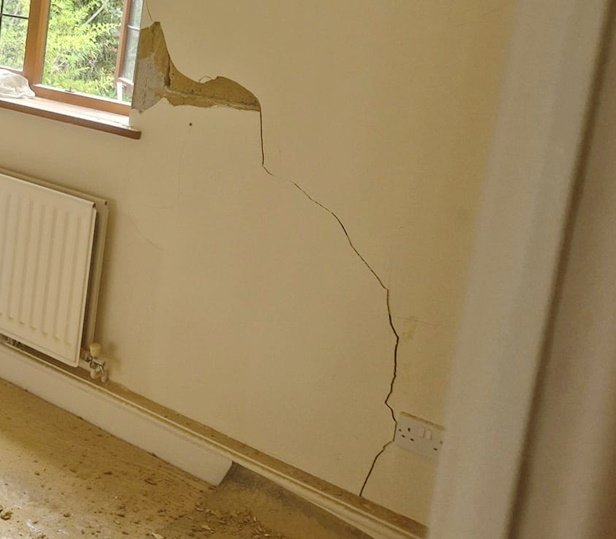
The causation of subsidence in a specific case
The cracks in this property in the London Borough of Bromley were caused by subsidence. The subsidence was located and identified adjacent to the areas of cracking within the external walls. After soil tests and laboratory analysis of tree roots close to and underneath the foundations, they were identified as poplar trees, which are well-known to consume copious amounts of water from clay soils.
It was concluded that the effect of these tree roots upon the soil caused the foundations to move, resulting in the cracking evident in the external walls, particularly internally to the wall finishes.
The trees were located on the property of an adjoining owner who did not want them removed. Therefore, to protect the property from further foundation damage, a tree root barrier was installed around the damaged areas.
The tree root barrier extended from ground level to approximately 4 m deep. This was positioned around part of the perimeter of the building where the damage was principally caused.
The extent of fracturing within the external walls was notably seen to recover, i.e. the cracks began to close up after 3-6months.
The main cause/source of the cracking was the subsidence, rectified by the installation of a tree barrier.
The cracking was a symptom of the cause/source, and the repair of the cracking is the repair of the symptom.
The repair of the symptom should not be undertaken until the cause/source of the cracking has been fully identified and rectified.
The repairs to the masonry cracks consisted of an approved chemical resin bonding.
The repairs to the wall plaster were carried out using the method attached to the link below.
It must be stated that cracking will continue to occur with subsidence rectification, but this will be to a lesser extent over a period of years. Therefore, the method we have stated below on how to repair cracks was the most appropriate for this particular case.
How to fix the crack
Once the primary causation of the crack has been rectified after a sufficient bedding-in period, repair work can begin to fix the crack and the affected decorations. Read More